Why "Widened" Channels Matter for Candy and Gummy Shapes
A standard pharmaceutical counting lane is cut for a fairly uniform, narrow object — a round tablet or a capsule with a consistent diameter. Gummy bears, hard candies, coated quail eggs and laundry beads are a different problem entirely: they are larger, they are frequently irregular or lobed in shape, and batch-to-batch size variation is simply part of working with a confectionery or novelty product rather than a defect to engineer around. The JF-10's ten channels are specifically widened and set up to pass this Φ3–40mm range of solid material without jamming or double-counting, which is the single most common failure point when a facility tries to force large candy pieces through counting equipment designed for a much smaller, more uniform target.
Standard Narrow Lane
Sized for small, uniform tablets and capsules; prone to jamming or false double-counts on larger or irregular pieces.
JF-10 Widened Lane
Built for Φ3–40mm solid candy and capsule shapes, keeping single-file flow through the channel even as piece size varies within a batch.
Materials and Bottle Formats This Machine Is Built For
The JF-10 is rated across a genuinely wide material range, from small capsule sizes shared with pharmaceutical lines through to full-size solid candy pieces. Round and square plastic bottles are both supported without switching the core counting head, which matters for confectionery brands running more than one container style across a product line.
0#–5# Capsules Soft Capsules Φ3–40mm Solid Candy Gummy Bears & Gummy Shapes Quail Eggs Laundry Beads / Pods Round Plastic Bottles Square Plastic Bottles
Where the JF-10 Gets Put to Work
Because the widened channel design bridges confectionery-scale pieces and smaller capsule-scale material, the same machine tends to serve a broader mix of product types than a dedicated tablet counter. The table below outlines the production contexts where this format shows up most often.
| Gummy & Candy Brands |
Multi-SKU confectionery lines filling round or square bottles with gummy bears, gummy shapes or hard candy, where piece size varies noticeably batch to batch and a fixed narrow lane would jam. |
| Nutraceutical Crossover Lines |
Facilities that run both softgel/capsule supplements and larger gummy-format supplements on the same floor benefit from one counter covering both ends of that size range. |
| Household & Novelty Goods |
Laundry bead and pod counting into retail bottles, where consistent fill count matters for consumer-facing packaging claims. |
| Specialty Food Packaging |
Quail egg and similar novelty food counting into retail containers, a use case that standard pharmaceutical counting equipment is not built to handle at all. |
Specification Summary
The tile grid below pulls together the confirmed specification for quick reference during line planning.
Counting Channels10 widened lanes
Applicable Bottle ShapeRound / Square
Filling Material Range0–5# capsule, soft capsule, Φ3–40mm candy
Production Capacity10–40 bottles/min
Bottling Volume Setting1–9,999 per bottle
Power SupplyAC220V, 50Hz, 1.5kW
Accuracy Rate> 99.5%
Air Pressure Required0.6 MPa
Overall Dimensions1360 × 1350 × 1650 mm
Net Weight420 kg
Reading the Accuracy Rate: What > 99.5% Actually Means on the Floor
A published accuracy rate is only useful once it is translated into what happens across a real production run. At better than 99.5% accuracy, a typical case of a few thousand bottles will see the count verified correctly on all but a very small handful, and that residual margin is exactly why quality-control spot checks remain part of any responsible packaging process rather than being treated as optional once a counter is installed. The widened-channel design contributes to holding that accuracy rate specifically because irregular or oversized pieces are the most common cause of miscounts on general-purpose counting equipment — solving the jamming problem at the channel level is what protects the count downstream.
Correctly counted bottles under normal operating conditions
Residual margin addressed through routine QC spot-checks
Figure reflects the manufacturer-rated accuracy under normal operating conditions with correctly calibrated channels; actual results vary with material consistency, channel maintenance and setup.
Production Capacity Across Different Piece Sizes
The 10–40 bottles/min capacity range exists because larger candy pieces simply take longer to pass through and settle in a channel than a small capsule does, even across the same ten lanes. The chart below illustrates how that capacity range typically shifts as the filled material gets larger and heavier.
Small capsules (Φ3–8mm)
~40/min
Mid-size candy (Φ10–20mm)
~28/min
Gummy bear shapes (Φ15–30mm)
~21/min
Large candy / quail egg (Φ30–40mm)
~12/min
Illustrative estimates within the 10–40 bottles/min rated range. Actual throughput depends on the specific material, bottle fill count and how the lifting feeder is tuned to the line.
Full Automation With a Lifting Feeder
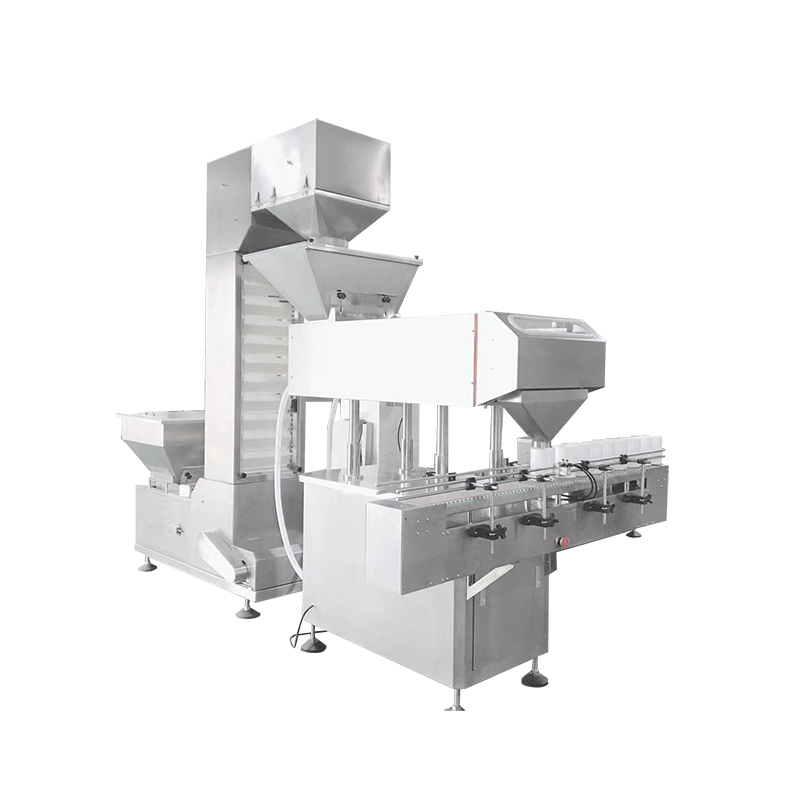
Unlike a desktop counting unit that an operator loads by hand, the JF-10 is designed to pair with a lifting (elevator) feeder that draws bulk candy or capsules from a floor-level bin and delivers a controlled, continuous stream to the ten counting channels above. This is what allows the machine to run as a genuinely full-automatic station rather than a semi-automatic one: once the feeder hopper is topped up, the counting and bottle-filling cycle continues without an operator manually refilling the counting head between rounds.
For most gummy and candy lines, the elevator feeder is what actually determines real-world uptime more than the counting channels themselves — a feeder tuned to deliver a steady, evenly distributed stream keeps all ten channels fed at a similar rate, while an under-tuned feeder can starve some channels while flooding others. If your facility is planning around the JF-10, it is worth discussing feeder hopper capacity and refill frequency alongside the counting specification itself, since that combination is what determines how long the line can run unattended between top-ups.
This also changes how a line supervisor should think about downtime. On a hand-loaded desktop counter, a pause to refill the hopper is a normal, expected part of the rhythm. On a feeder-fed system like the JF-10, an unplanned stop is more often a sign that the feeder has run dry, that material has bridged inside the hopper, or that a channel has partially blocked — worth building into operator training as the first three things to check before assuming a fault with the counting head itself.
From Bulk Bin to Sealed Bottle: The Production Cycle
Bulk Loading
Candy, capsules or beads are loaded into the elevator feeder's intake bin in bulk.
Lift & Distribute
The feeder lifts material and spreads it evenly across the ten channel inlets.
Widened-Channel Counting
Each of the ten lanes counts pieces individually as they pass through in single file.
Target Count Reached
The control system halts the count once the pre-set 1–9,999 target for that bottle is met.
Bottle Indexing
Filled round or square bottles move on and the next empty container indexes into place.
Continuous Cycle
The cycle repeats automatically as long as the feeder hopper remains supplied.
Site Preparation: Power and Compressed Air
Because the JF-10 runs pneumatically assisted mechanisms alongside its electrical drive, site preparation involves more than just an electrical outlet. Confirming both utilities ahead of delivery avoids installation delays.
Electrical Supply
AC220V at 50Hz, drawing 1.5kW. A standard single-phase industrial circuit is normally sufficient, but confirm local voltage and frequency compatibility before ordering if your site does not run 220V/50Hz as standard.
Compressed Air Supply
0.6 MPa working air pressure is required for the pneumatic elements of the counting and filling cycle. A dedicated or shared compressor line rated to reliably hold this pressure under load should be confirmed as part of site planning.
The overall footprint of 1360 × 1350 × 1650 mm at 420 kg also means floor loading and clearance for the lifting feeder should be checked against the intended installation area, particularly if the machine is going into an upper floor of a multi-story facility rather than a ground-level production hall.
It is worth walking through these utility requirements with your facilities team before the machine ships rather than after it arrives — running a temporary electrical drop or a portable compressor for commissioning is a common workaround, but it is not something to plan around for ongoing production. If your existing compressed air system is already shared across several machines, confirm that adding the JF-10's 0.6 MPa draw does not pull the rest of the line below its own required pressure during peak operation.
Keeping Ten Channels Running Evenly
With ten parallel lanes instead of four, uneven wear or a single partially blocked channel is easier to miss during a casual visual check but has a proportionally smaller impact on total output than it would on a lower-channel machine — one blocked lane out of ten is a 10% capacity loss rather than a full stoppage. Even so, a short routine check keeps all ten lanes contributing evenly rather than quietly compensating for one or two underperforming channels.
- Check each of the ten channels visually at shift start for residue from sugar-coated or sticky candy surfaces.
- Confirm the elevator feeder is distributing material evenly across all channel inlets, not concentrating flow on the center lanes.
- Verify compressed air pressure holds steady at 0.6 MPa during continuous operation, not just at startup.
- Clean sticky residue from gummy or sugar-coated candy promptly rather than letting it accumulate between shifts.
- Recalibrate the bottling volume setting whenever switching between materials of noticeably different size or density.
- Inspect bottle indexing mechanism alignment periodically to prevent partial fills from misaligned containers.
Counting by Piece vs. Filling by Weight: Which Suits Candy Packaging
Confectionery and novelty-goods packers sometimes default to a checkweigher or weight-based filler out of habit, without weighing it against piece counting for their specific product. Both approaches are legitimate, but they answer a different question: a checkweigher confirms that a bottle's total contents fall within a target weight range, while a piece counter like the JF-10 confirms an exact number of individual units regardless of small weight variation between pieces. For candy, gummies and quail eggs, where consumers and retailers often expect a stated piece count on the label rather than a stated weight, exact counting is usually the more defensible packaging claim.
| Best Suited To |
Piece counting: products sold or labeled by unit count. Weight filling: bulk or loose-fill products sold by total weight rather than piece count. |
| Accuracy Definition |
Piece counting: exact number of units per bottle. Weight filling: total mass within a tolerance band, which can still under- or over-fill on piece count if unit weight varies. |
| Size/Weight Variation |
Piece counting handles natural size variation in candy or gummy shapes without affecting the stated count. Weight filling can be thrown off by the same variation, since heavier or lighter pieces shift the count within a fixed weight target. |
| Typical Fit for This Machine |
The JF-10's widened channels are built specifically for exact piece counting across a wide material size range — from small capsules to large candy — where a stated unit count matters more than total fill weight. |
In practice, some facilities run both: a piece counter for the primary retail count claim, with an in-line checkweigher afterward as a secondary verification step. If your product line already includes a checkweigher, the JF-10 can typically sit ahead of it in the same packaging sequence rather than replacing it outright.
10-Lane vs. Smaller Desktop Counters: Matching the Machine to the Line
Not every candy or capsule packaging operation needs a full-automatic, feeder-fed machine like the JF-10. Facilities running small trial batches, a single low-volume SKU, or working in a lab-scale setting are often better served by a compact semi-automatic desktop counter — the kind of unit more commonly used for standard tablet and capsule counting — where an operator loads material by hand and manages the count directly. The JF-10's ten widened channels and elevator feed start to pay off once a line is running larger candy formats at meaningful daily volume, where hand-loading a hopper repeatedly throughout a shift becomes the actual bottleneck rather than the counting speed itself.
The practical dividing line is less about "automatic versus semi-automatic" as a feature checklist and more about whether your product is large or irregular enough to need widened channels in the first place, and whether your daily volume justifies feeding the line continuously rather than by hand. A facility only occasionally packing gummy-format products alongside a primarily tablet-based line may still be well served by a smaller counter with an adjustable channel width; a dedicated confectionery or novelty-goods packaging operation running candy or beads every day is the clearer fit for the JF-10's format.
Frequently Asked Questions
Can the JF-10 count both small capsules and large candy pieces without changing parts?
Yes. The widened channels are built to cover the full 0–5# capsule through Φ3–40mm candy range, so the same ten lanes handle both ends of that size spectrum without a hardware swap, though the bottling volume setting should be reconfirmed for each material.
Does this machine need a separate lifting feeder, or is one included?
The counting and bottling unit is designed to work with a lifting (elevator) feeder for full automation. Confirm with our sales team whether your order should include a matched feeder or whether you are integrating with an existing one.
Does the accuracy rate hold the same for laundry beads and quail eggs as it does for candy?
The rated accuracy applies across the machine's supported material range, but novelty items like quail eggs or laundry pods often have more shell or surface variation than manufactured candy, so a short sample run with your exact product is worth requesting before committing to a fill-count target.
What happens if my compressed air supply can't consistently hold 0.6 MPa?
Inconsistent air pressure can affect the pneumatic elements of the counting and filling cycle. It's worth confirming your compressor's sustained output, not just its peak rating, against the 0.6 MPa requirement before installation.
Can it fill both round and square bottles on the same production run?
The machine supports both round and square plastic bottle shapes. Switching between the two within the same day is a setup adjustment rather than a full changeover, though exact reconfiguration time depends on your specific container dimensions.
How is the bottling volume actually set, and how wide is the range?
The bottling volume is configured on the control system with a setting range from 1 to 9,999 pieces per bottle, covering everything from small trial counts to large bulk-fill containers on the same machine.
What accuracy rate should I expect once the machine is running my specific product?
The machine is rated above 99.5% accuracy under normal operating conditions. Material consistency and how well the feeder distributes product across all ten channels are the two biggest factors in whether a specific line reaches that rating in practice.
Is this machine suitable for sticky or sugar-coated candy?
It can run sugar-coated and sticky-surfaced candy, but these materials require more frequent channel cleaning than dry capsules or hard candy, since residue buildup is the main cause of reduced channel accuracy on sticky products.
How much floor space and clearance should we plan for around the machine?
Beyond the 1360 × 1350 × 1650 mm machine footprint, plan additional clearance for the lifting feeder and for operator access to the bulk intake bin and bottle output side of the line.
Manufacturing Background
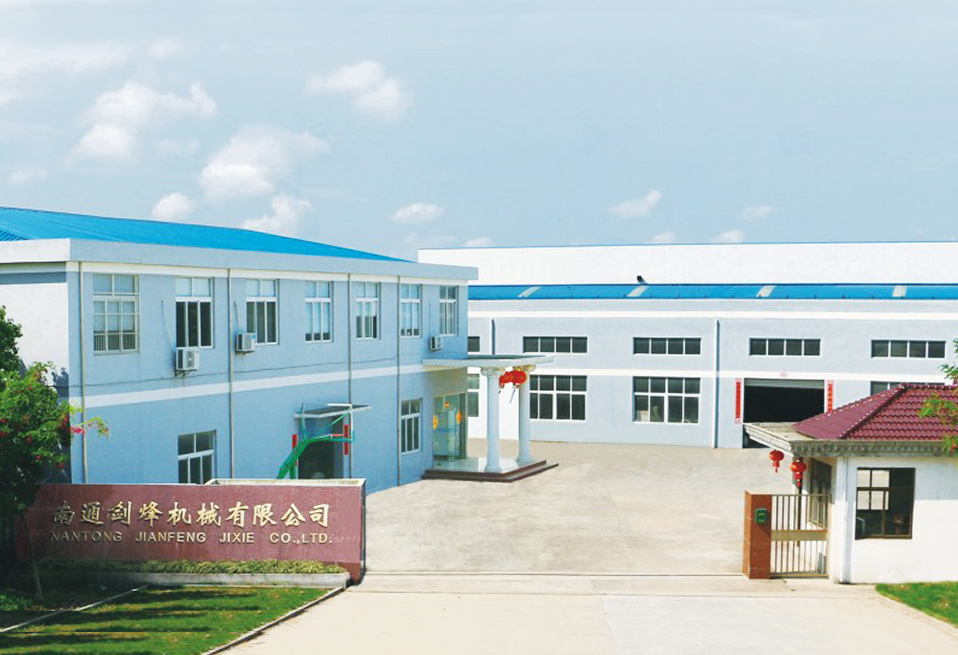
The JF-10 is engineered and produced by Nantong Jianfeng Machinery Co., Ltd., a pharmaceutical and food machinery manufacturer operating since 1984 from its own campus in Nantong, Jiangsu Province, within convenient reach of Shanghai's ports and air freight connections. Design, R&D, manufacturing, installation and commissioning are handled as a single in-house process across the company's 12,000-square-meter site, rather than split across outside contractors — a structure that matters most for equipment like the JF-10, where counting accuracy, feeder integration and pneumatic reliability all depend on how well the mechanical, electrical and control-system teams coordinate during design.
1984Founded
12,000 m²Factory Campus
CE / ISOCertified since 2015
7Utility Model Patents
CE and ISO product certification was completed in 2015, followed by seven utility model patents granted by the State Intellectual Property Office in 2016, covering equipment across the company's counting, bagging, capping and labeling lineup. That patent and certification history sits alongside decades of hands-on manufacturing for pharmaceutical and food packaging clients reached through export markets, which is the practical foundation the JF-10's widened-channel and feeder-integration engineering is built on.
Customization Options Available on Request
Channel Width Tuning
Lane width adjusted at the factory for your specific candy or capsule size range.
Feeder Matching
Elevator feeder hopper capacity sized to your target unattended run time.
Voltage Configuration
Electrical setup adapted where local supply differs from AC220V/50Hz.
Bottle Guide Sets
Additional guide fittings supplied for switching between round and square containers.
Control Panel Language
Interface and documentation prepared in your required language.
Line Integration Support
Guidance on positioning the JF-10 alongside capping, labeling or induction sealing equipment already on your line.
Planning a candy, gummy or capsule-crossover line around the JF-10? Send your target piece size, bottle format and expected daily volume, and our engineering team will confirm feeder sizing, realistic throughput for your product, and a tailored quotation.



 English
 Français
 русский
 Español
 中文简体




 +86-159 6291 3930
 +86-513-86205069

 Wujia Industrial Park, Dongshe Town, Tongzhou District, Nantong City Jiangsu Province, China
